Research, text and photos by Anton Mans, August 2025
The Tree and trails are situated in the Garden Route National Park. The carpark and start of the trails (33°56’08″S 22°38’43″E) are located off Seven Passes Road. From Wilderness drive east for 3.4km along the N2, to the turnoff left to Hoekwil. Follow Hoekwil Road, which becomes Seven Passes Road for 3.4 km until you reach the sign-posted turnoff to the Big Tree carpark. SANParks Wild Cards are accepted. Otherwise, entrance fees are R29 for adults and R16 for children. There are braai spots with picnic tables near the car park, but scattered around the Tree there are some beautiful sites within the forest.
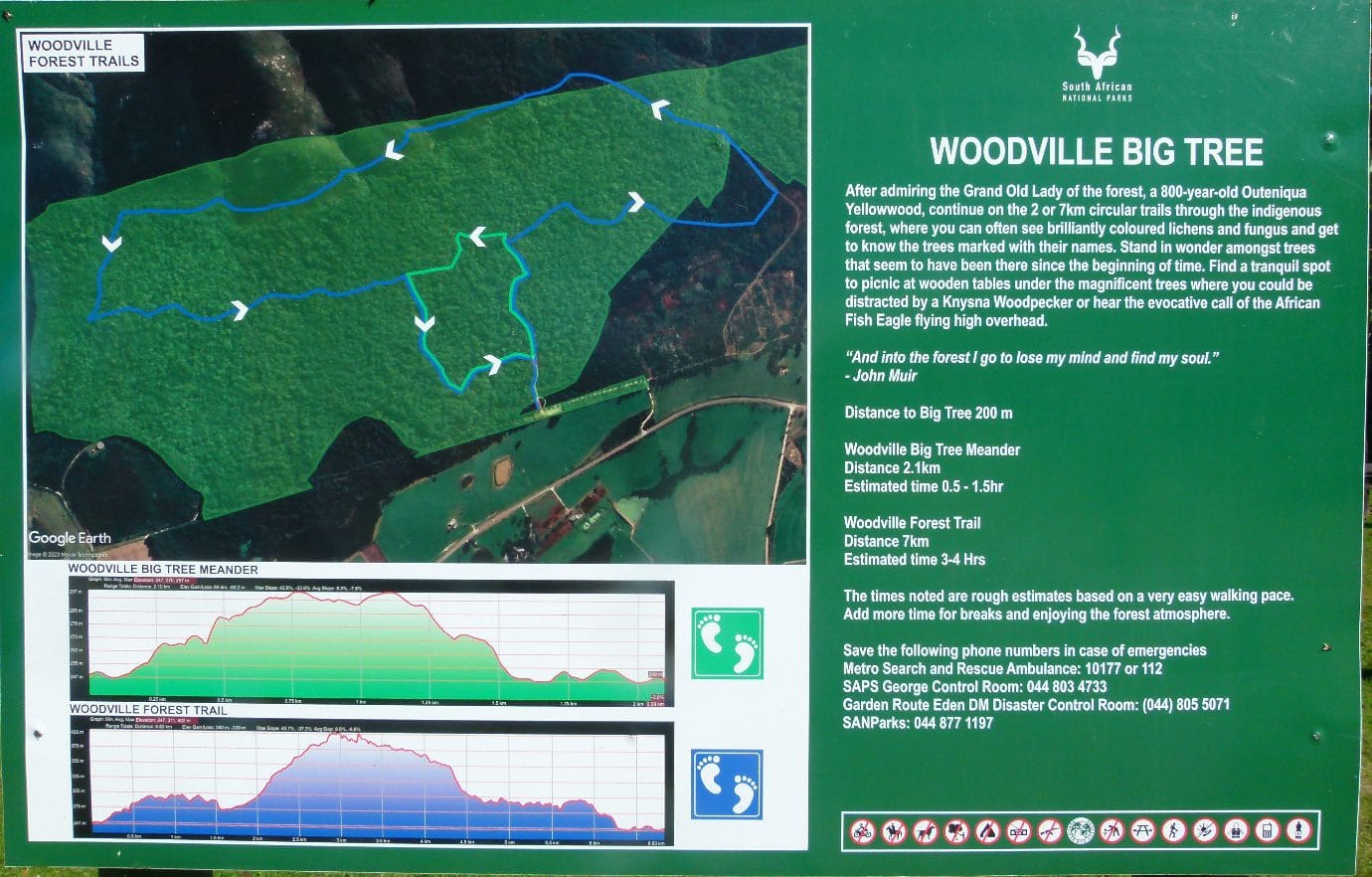
The Tree is just a short walk from the SANParks office and from there are two circular trails, 2km and 7km each (see Figure 1). The 2km route is an easy ramble through the forest, while the 7km option is an easy to moderate walk, through dense forest followed by a fairly steep incline with a height gain of about 130m. Here you emerge from the trees and have spectacular views all the way to the Indian Ocean.

Figure 1. Route information and profiles taken from SANParks information board
The Big Tree is an Outeniqua Yellowwood, an evergreen conifer (gymnosperm) of the podocarpaceae family. It is estimated to be more than 800 years old. To put that into perspective, when it was a sapling, Genghis Khan was besieging Bukhara and Samarkand, and the Fifth Crusade was underway. For further information about the Tree see Figure 3.
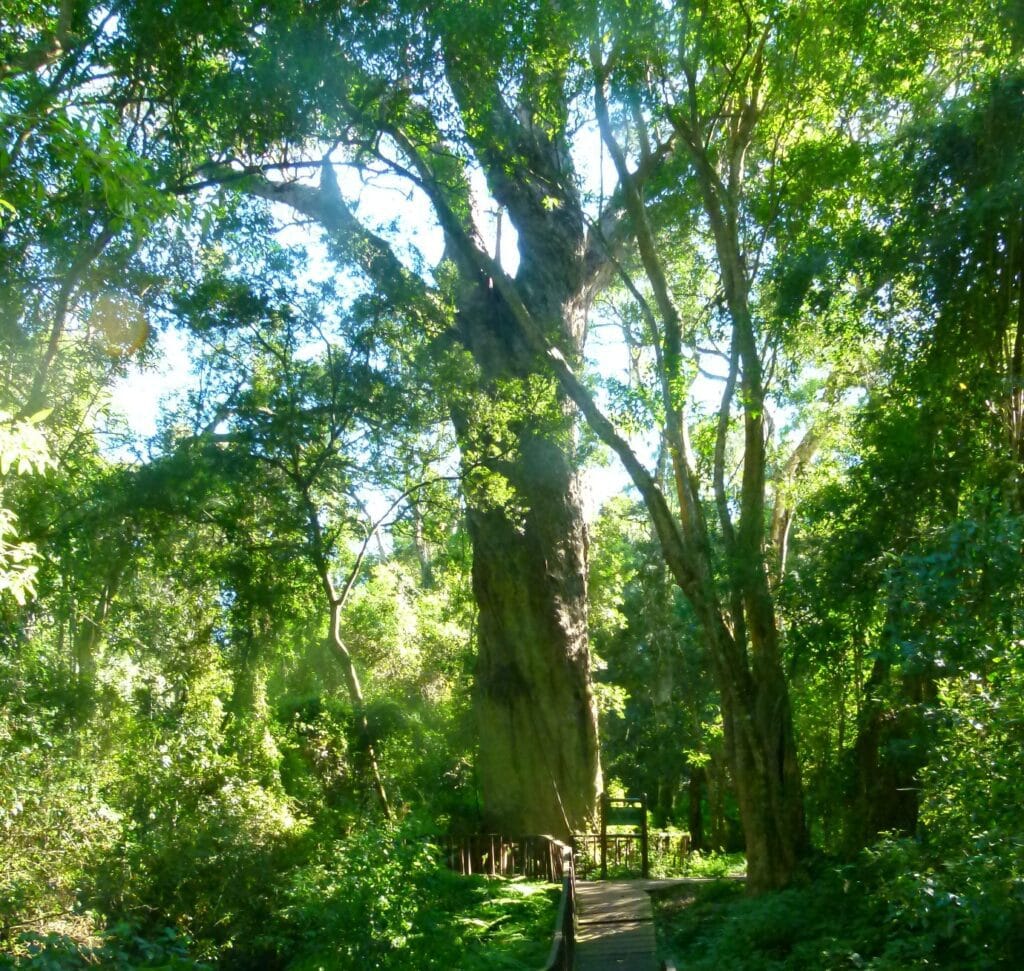
Figure 2. A photo of the Tree does not really give a good indication of its size. A visit is needed to really appreciate its majesty
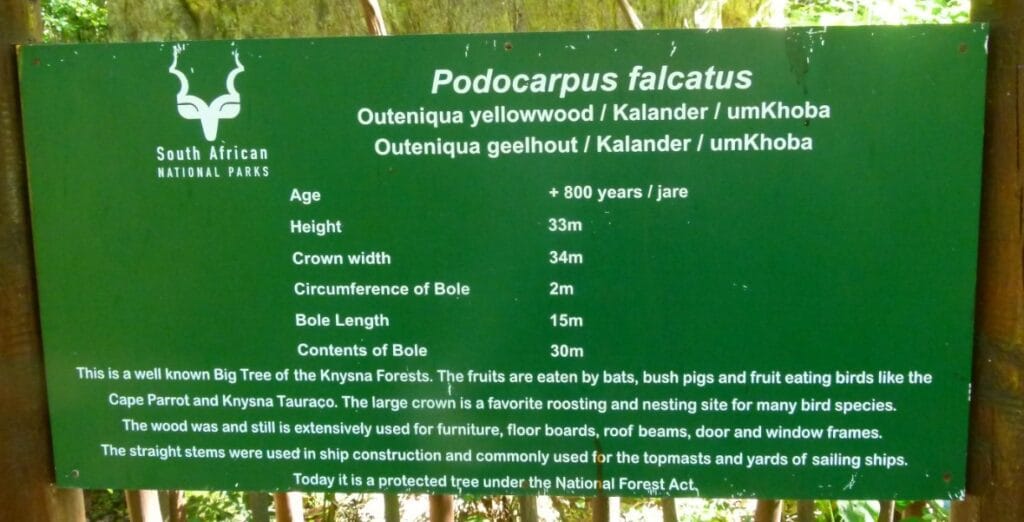
Figure 3. Statistics of the Big Tree
The surrounding forest is classified as Southern Cape Afrotemperate Forest which is a tall, dense, species-rich forest, occurring in moist and warm temperate climate. It is part of the Knysna-Tsitsikamma forest which extends from Mossel Bay to Humansdorp and is the largest forest complex in southern Africa. Rainfall occurs year-round, and ranges from 525 mm to 1220 mm per year. Besides yellowwoods which dominate, well-established forest trees can be seen; some are labelled, including Ironwoods, Common saffron, White elder, Candlewood and Stinkwood.
The forests are home to African leopard, bushbuck, blue duiker, bushpig and other smaller mammals, such as fruit bats, who along with bushpigs and some bird species, feed on and therefore distribute the yellowwood seeds. The density and assortment of birds is not exceptionally high, but they certainly can be heard. Some examples include Buff-spotted Flufftail, Narina Trogon, Knysna Tauraco, seven species of cuckoo, Knysna Woodpecker, Chorister Robin-Chat, Crowned Eagle and African Wood Owl.
Although the forests are not really continuous from Knysna to Woodville, no article about them would be complete without a mention of the Knysna elephants.
The elephants didn’t always live in the forests; they retreated into them in the 19th and early 20th centuries when their numbers were vastly reduced by hunting, either for sport, ivory or as they were considered a nuisance to farming. In1994, attempts to increase the herd by introducing elephants from the Kruger National Park, failed. Eventually it was believed that there was only one elephant left in the area, until in 2000, a forest guard saw and photographed a young bull from a distance of about 30 metres (Knysna Museums). This prompted the author and independent researcher, Gareth Patterson, to begin his search for the elephants the following year and to publish his findings in his 2011 book.
For seven years, “he covered thousands of kilometres on foot, following ancient elephant paths through the dense Afromontane forest and the surrounding mountain fynbos. He found abundant signs to suggest that, far from dying out, the Knysna elephants are, quietly and secretly, holding their own. Patterson’s fieldwork, and his DNA research in collaboration with conservation geneticist Lori Eggert, established that at least five young females exist, lending support to Patterson’s growing evidence that the Knysna forest and its surroundings are home to a small herd of young elephants.” (Patterson 2011)
However, SANParks officials and local conservationists disagreed with Patterson’s findings. An extensive scientific study led by ecologist Lizette Moolman in 2014 which included photos from 80 remote camera traps installed across the Knysna forest, concluded that there is only a single cow, aged about 45 years old, left in the area. Various research studies and proposals are being considered with regard to the best course of action to ensure her survival, potential companionship, protection and wellbeing.
References
Knysna Museums. https://www.knysnamuseums.co.za/pages/the-knysna-elephants
Patterson, G. 2011. The Secret Elephants: The Rediscovery of the World’s Most Southerly Elephants. Penguin Random House South Africa