Research and text by Ross Arkert, August 2025
See Kaaimans River Railway Bridge for more historic background.
The idea for a railway line connecting George and Knysna dates back to 1907 when the Mossel Bay line had arrived in George. However, it was not until the early 1920s that the economic depression placed pressure on the government to provide employment for poor white poverty relief. In 1921, the government announced that the next railway development to be considered would be the George-Knysna line, which would pass through Wilderness.
Work on the new line started simultaneously from both George and Knysna in 1924. In the original plan, the railway was to be built over the village green and along the north bank of the lagoon. This would have wiped out the forest road to Fairy Knowe as well as many of the residential plots along Waterside Road, effectively cutting off the village from the lagoon. Owen Grant, the major shareholder of the Wilderness (1921) Ltd., together with chairman, Jack Raubenheimer, managed to have the route diverted to the southern bank of the lagoon, then a wide sand dune.

Lagoon at the mouth of the Touw river before the railway, 1915 (Source: Hugo Leggatt)
The construction of the railway was not without its problems. Storms washed away the support structures of the bridge over the Kaaimans River and delayed completion by a year. A tragedy occurred at a cutting at Duiwerivier on the 8th of April 1926 when six workmen were buried in a landslide. While one man was rescued, he later died in hospital. All his companions perished in the disaster. By April 1928 the George & Knysna Herald was complaining that at a cost of £420,000, or about £10,000 per mile, the George-Knysna railway was one of the most expensive pieces of construction in the country.
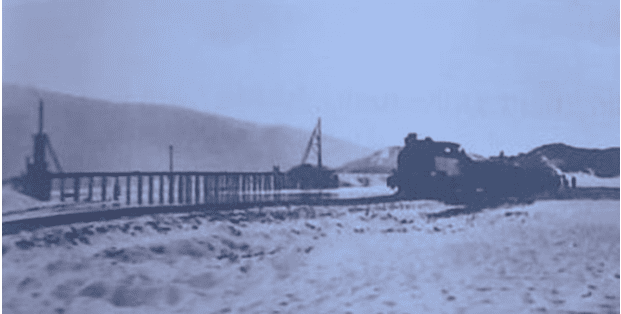
Railway construction on Wilderness Beach, 1926 (Source: Hugo Leggatt)
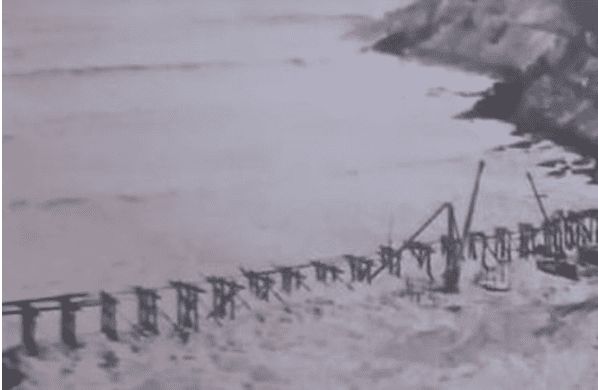
Early Work at Kaaimans Mouth, 1926 (Source: Hugo Leggatt)
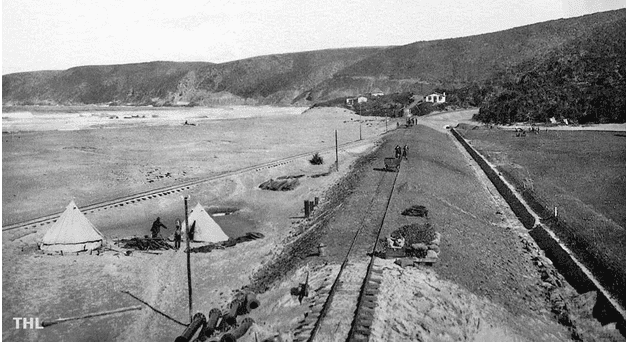
Construction of the railway in Wilderness
On the 17th of October 1928, the railway line was finally open. Charlie Malan, together with other officials and about 300 schoolchildren, travelled by train from George to Knysna for the opening. On arrival in Knysna, the train passed under a flower-decked arch, smashing a suspended champagne bottle as it did so. However, in November the line had to be closed for a fortnight to complete the final work on the Kaaimans bridge, finally re-opening on the 30th of November.
Three years after the railway was opened it was put to the test. Torrential rains fell between Christmas 1931 and New Year. The water rose virtually to the level of the rails. A train packed with holidaymakers was marooned on higher ground near Rondevlei when the line succumbed to severe pressure on the Freesia Rock bridge. Four massive columns sank a metre or more into the sandbed below, while the whole of the overhead steel structure was destroyed. There were fears that the new line would be out of action for a year or two, but, totally against the rules, Major Stanford, the engineer in charge of building the original line, decided that the columns had sunk as far as they were likely to go and so cast four brand new columns on top of their sunken predecessors.
The George-Knysna line helped connect farmers in the area with the network of railways covering the sub-continent. Steam trains were used to transport timber, agricultural goods, and passengers between George, Wilderness, and Knysna. Whites Road, built between 1905 and 1908, provided motorists with access to Wilderness, but the area remained remote. The railway line allowed tourists to easily visit Wilderness. After the building of the railway Wilderness flourished as a holiday destination. The railway also made it easy for locals to travel up to George on the morning passenger train, do their shopping and socialising and return to Wilderness after lunch.
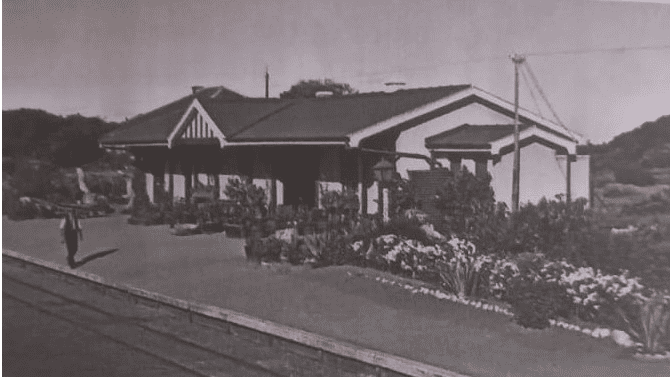
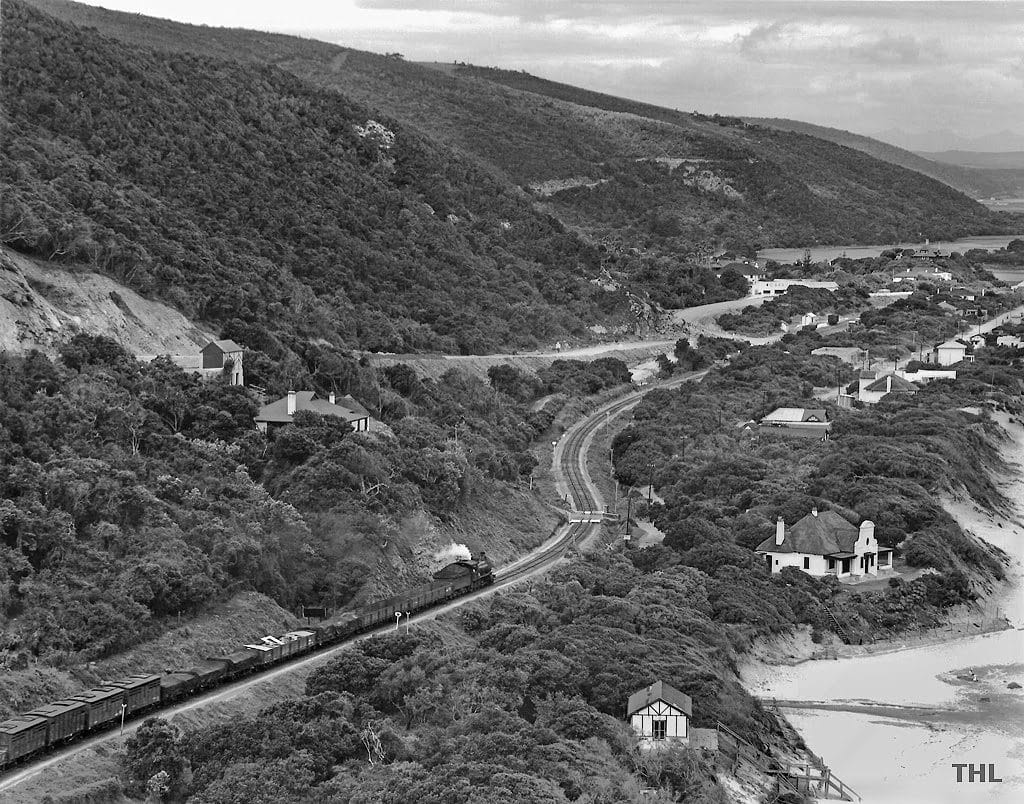
Wilderness Station, 1934 (Courtesy of the Transnet Heritage Library, THL N42519)

The bridge of Kaaimans River 1931
In 1928 the S.A. Railways & Harbours Magazine described travelling from George to Knysna as “being present at an animated art exhibition, each mile presenting a new canvas that calls forth exclamations of pleasure.” Winding rapidly down to the sea, past fern-covered hills and deep gullies studded with wildflowers, the first glimpse of the ocean was obtained at Victoria Bay. Many feet below the tracks, the waves, dashing themselves against the rocks, sent up a fine spray. Through two tunnels of moderate length cut into the hills above the sea, the train approached the Kaaimans River. As the traveller emerged from the last tunnel the scene opened up in all its glory, the golden beaches and enticing woodland of the Wilderness. The Wilderness Station was the only station on the line between George and Knysna. The station was prettily set against the background of the forest-clad hills and within easy access of the beach and hotel. The station’s design reflects early 20th-century railway architecture, characterized by its modest size and functional layout, typical of rural stations of that era.
A notable visitor to the station was George Bernard Shaw, who won the 1925 Nobel Prize for literature and arrived at the station in 1932. During the Second World War the RAF established 61 Air School in George. By 1943 there were nearly 500 young single men stationed at the 61 Air School. The Dumbletons at Fairy Knowe allowed many of these to set up tents on the hotel grounds. The men with weekend leave would travel down by rail and arrive at the station on Friday, set up a tent at Fairy Knowe and dance the night away at the Wilderness Hotel on a Saturday.
In the 1960s the station garden regularly won the Lady Ducan trophy for the best station garden. A drought occurred in 1968 which caused the station master, Mr. J. Jonker, some concern. Luckily a railway tanker from Mossel Bay arrived with over 20,000 litres of water and he was able to hand spray his plants.

Wilderness Station in the 1960s (Source: George Museum Archive)
Unfortunately, the rail service to Wilderness was short-lived. In 1952 the N2 highway was complete. With George and Knysna linked by a modern tarred road, there was less need for passenger trains. The new road soon made motor transport a more popular option and in 1964 the passenger service on trains was withdrawn and replaced by a single coach attached to the goods train. In 1977, the passing of the Road Transportation Act deregulated goods transported by road. This led to a shift from rail to road as the major means of goods transport and put financial pressure on the local line.
Several attempts were made to promote the tourist value of the steam trains. Then in 1991 the line was declared a preserved steam line and handed over to the Transnet Heritage Foundation. Several trains, with names such as Rosie, Noeline and Tootsie ran on this line. One train named Trudie, driven by Mossie van Rensburg, carried a disk reading “Outeniqua Choo Tjoe.” The Heritage Foundation adopted the name for a popular passenger service which was re-introduced. The Outeniqua Choo Tjoe left from the Railway Museum in George in the morning and arrived in Knysna in time for lunch, before returning in the afternoon. At its outset, it attracted around 40,000 passengers a year, which rose to 115,000 ten years later. Many travellers fondly recalled journeys on the Outeniqua Choo Tjoe, highlighting the breathtaking scenery, the nostalgic experience of steam travel, and stops at quaint stations like Wilderness.

Mossie van Rensburg in the cab of his train (Source: Hugo Leggatt)

Painting of the Outeniqua Choo Tjoe (Source: George Museum Archive, box 51)
Unfortunately, some hot dry summers at the turn of the millennium led to fires along the tracks with the steam engines needing to be replaced with diesel ones as a result. Then in 2006, severe flooding brought the nearly 80 years of trains running on the George-Knysna line to an end. The floods led to mudslides which settled on the track where they still lie some 20 years later. For a while, the Choo Tjoe was switched to the George-Mossel Bay line, but this failed to have the same appeal. Transnet looked for a new operator without success and the trains ceased operating in 2010. Nowadays the track disappears into the undergrowth, the bridges slowly rust in the sea mists and the rail fastenings are stolen.

The Railway line today (Source: George Museum Archive, box 51)
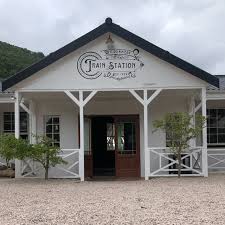
Currently, Wilderness Station no longer functions as an active railway station. The building and surrounding area have been repurposed for community events and tourism-related activities, serving as a historical landmark and a reminder of the region’s rich railway heritage.
Editor’s note: In October 2025, it was announced that the iconic Outeniqua Choo-Tjoe would be restored. Read more…
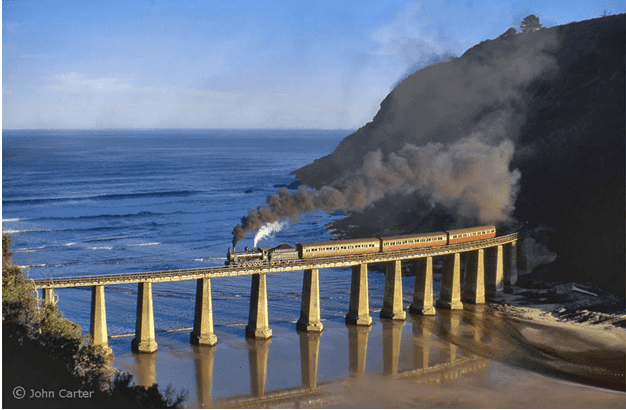
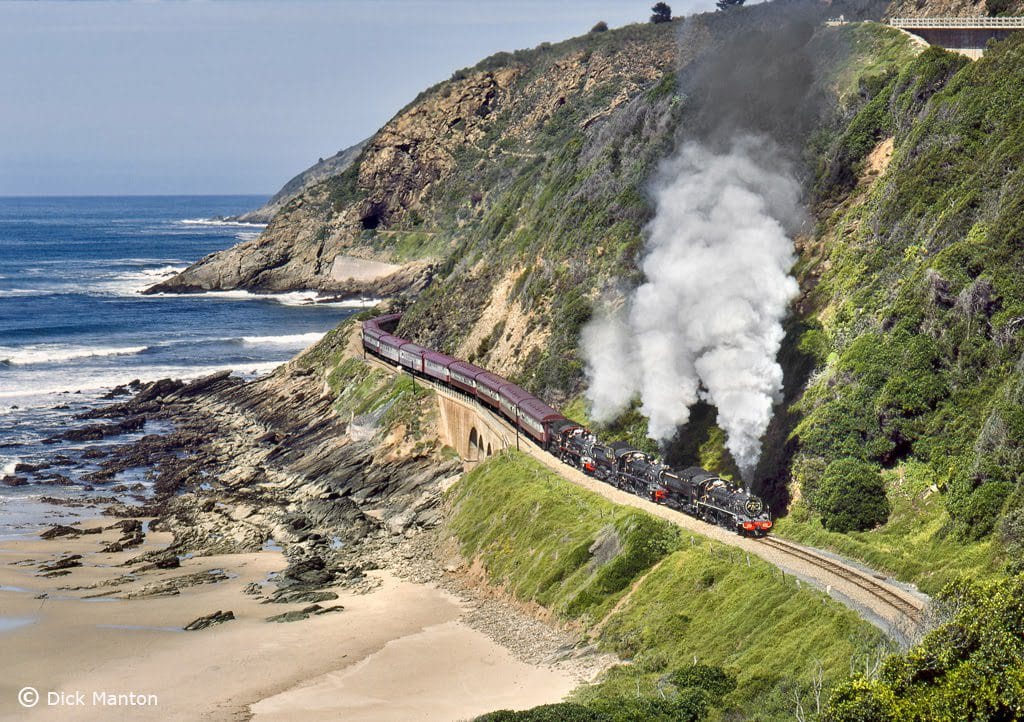
Steam train over Kaaimans (Photo: John Carter)
References
“George Museum Archive,” Box 51.
Leggatt, Hugo. Wilderness: Gateway to the Garden Route. George: Hugo Leggatt, 2020.
Leggatt, Hugo, Victor Smith, and John Brownlee. Wilderness: The Village with a Difference. Wilderness: Wilderness Eco Tourism Association, 1997.
“Opening of the George-Knysna Railway Line, 1928 – Outeniqua Choo Tjoe,” May 2, 2017. https://www.outeniquachootjoe.com/blog/post/opening-of-the-george-knysna-railway-line-1928/.
Thompson, Lynne. Interviewed March 18, 2025.
Van Rooyen, Lizl. Interviewed May 13, 2025.